
History of the Heidelberg Catechism
What is the Catechism? When did it take place? What's the story? What's the history? What's the backdrop? All these questions should be answered for us to better understand d the Catechism. Upon doing research for his topic, I came across this piece written by Dr. Lyle Bierma, who is a professor of church history at Calvin. He does such a wonderful job of giving us a history of the Heidelberg Catechism that I am going to share his piece with you today.
“What is your only comfort in life and in death? That I am not my own, but belong body and soul in life and in death to my faithful Savior, Jesus Christ. These are the opening lines of the most famous question and answer of probably the most famous Catechism of the 16th century, the Heidelberg Catechism of 1563. Within a few months of its appearance, Heinrich Bollinger, leader of the Reformed Church in Zurich, was hailing it as the best Catechism ever published.
It was soon translated from German into Latin, Dutch, English, French, Greek, and Hungarian, and today it can be found in every European language and dozens of African and Asian languages as well. Many scholars regard it as the most ironic and Catholic expression of the Christian faith to come out of the Protestant Reformation. It is certainly among the most beloved. Such worldwide acclaim for this document, however, makes it easy to forget that it was originally written to a particular audience in a particular place for a particular reason. Its fulltitle: Catechism or Christian Instruction, as this is conducted in churches and schools of the Electoral Palatate. This provides some clues to the background of the Catechism.
Catechism Background
First, although the Catechism was written and published in the city of Heidelberg, Germany, it was intended for use in the entire territory of which Heidelberg was the capital. This territory was known as the Electoral Palatate, one of some 300 small states that made up the Holy Roman or German Empire in the 16th century.
Second, the Catechism was to provide instruction in both the churches and schools of the territory. The Palatate had become officially Protestant Lutheran in 1546, relatively late when one recalls that Luther had triggered the Reformation in another part of Germany almost 30 years before. When the political leader of the Palatate, Elector Frederick III, came to power in 1559, he conducted a visitation of the churches in his realm to assess their spiritual progress. What he found was disheartening.
The young people were growing up, quote, without the fear of God and the knowledge of his word. Where doctrinal instruction was being offered, teachers and preachers were using a variety of catechisms and some instructors were even confusing their students with irrelevant questions and unsound teachings. If we are really to bring about the Reformation in our territory, Frederick III concluded, the place to begin is with the training of our children, youth ministry. And for that, we need a single clear guide to biblical truth and instructors who teach and live by that guide.
Finally, the full title of the catechism refers to Christian instruction in churches and schools. This may indicate a deliberate attempt on Frederick's part to avoid such labels as Lutheran or Calvinist or Zwinglian. The only lawful form of Protestantism in the German Empire at that time was Lutheranism, as defined by the Augsburg Confession of 1530. Frederick's predecessor, however, had opened the palatate to followers not only of Luther, but also of Melanchthon, Bollinger, and Calvin. And Frederick III continued this policy as he became increasingly attracted to certain reformed ideas.
Writing the Heidelberg Catechism
To help achieve religious and political stability in this realm, therefore, Frederick commissioned a catechism that would offer instruction in the fundamentals of the Christian faith, a summary of biblical doctrine that minimized differences and emphasized consensus among the Protestant factions in the territory. The production of such a catechism was assigned in 1562 to a team of Heidelberg ministers and university theologians under the watchful eye of Frederick himself. Two young members of the team, Zacharias Usenius and Caspar Olivianus, are often identified as the co-authors.
But the consensus among scholars today is that Arsenius was the primary writer and Olivianus had a lesser role. Arsenius was particularly well suited to the task, not only because of his moderate, irenic disposition, but also because he had studied under leading theologians from different Protestant traditions in Wittenberg, Zurich, and Geneva. The team perused and even borrowed language from a number of earlier catechisms, both Lutheran and Reformed, and within less than a year brought the final draft of their work to a synod in Heidelberg for approval.
The finished product had scripture references under each question and answer and was divided into 52 sections, or Lord's Days, so that a minister could cover the entire catechism once a year in doctrinal sermons at the afternoon worship service. The afternoon worship service was the one between the morning and the evening. When the Heidelberg Catechism first appeared in 1563, therefore, no one could have imagined that it was destined for greatness. Its main author was an unknown theology professor not yet 29 years old. It was composed for the schools and churches of one small state in a corner of the German Empire, and in many respects it was similar to scores of other Protestant catechisms circulating at the time. Why then would this document eventually stand out from the rest? Part of the answer lies in what distinguished the Heidelberg Catechism from its relatives.
Like the others, it provided an explanation of the basic elements of the Christian faith—the Apostles' Creed, the Ten Commandments, the Lord's Prayer, and the Sacraments. What is distinctive about the Heidelberg Catechism, however, is that it connects these explanations to a single overarching theme—the theme of comfort introduced in the first question and answer as quoted above. In order to live and die in the joy of that comfort, I must know three things—how great my sin and misery are, how I am delivered from such sin and misery, and how I can live in gratitude to God for such deliverance. These sub-themes of misery, deliverance, and gratitude form the three major divisions of the Heidelberg Catechism, and the expositions of the basic elements of Christianity are woven through them. I come to know my misery through the summary of the Ten Commandments—that's in questions and answers three through five. I come to know my deliverance through the gospel as summarized in the Apostles' Creed—that's questions and answers 19 through 58. And I am assured of that deliverance through the Sacraments—that's questions and answers 65 through 85. Finally, it is through the individual Ten Commandments—question and answers 92 through 115, and the Lord's Prayer—question and answers 116 through 129—that I come to know ways of expressing my gratitude for this deliverance.
In short, the Heidelberg Catechism directs all the fundamentals of the Christian faith toward the comfort of the believer. In choosing comfort as the central motif of the Heidelberg Catechism, the authors were addressing the spiritual anxieties of the day. Against the background of a Roman Catholic sacramental system that required works of penance to help pay for one's sins, the Heidelberg Catechism proclaims the comfort of belonging to Christ, who has fully paid for all my sins, as question and answer one says. In an age of constant war and famine, disaster and plague, the Heidelberg Catechism proclaims comfort of belonging to a Christ who, quote, watches over me in such a way that all things must work together for my salvation.
Over against a late medieval piety that encouraged people to do their best and then hope for the best, the Heidelberg Catechism proclaims the comfort of belonging to a Christ who by his Holy Spirit assures me of eternal life. Some have criticized this approach as too human-centered, but it is here that the Heidelberg Catechism shows itself as, first of all, a pastoral document sensitive to the spiritual discomfort of its audience in responding with the comforting truths of the gospel. This personal practical approach to doctrine carries over into the rest of the Catechism as well.For example, the Heidelberg Catechism treats each one of the articles of the Apostles' Creed not just as facts to be explained, but also as promises of God made real in the lives of believers. It doesn't just ask, what does this article of the Creed mean? But also, how does this teaching benefit you? How does this comfort you? In this section on the sacraments, it emphasizes the assurance of salvation that comes from the washing of water and partaking of the supper. In the exposition of the Decalogue, it not only relates the commandments to the realities of life, but examines the positive lifestyle implied in the prohibitions of the moral law.And it doesn't just interpret the petitions of the Lord's Prayer, it places them in extended paraphrase on the lips of the praying community.
Surprisingly, the Heidelberg Catechism is silent, or at least muted, on certain teachings that are often associated with the Reformed theological tradition. Election, reprobation, covenant, limited atonement, perseverance of the saints, and strict Sabbatarianism.Why then has this document had such an extraordinary staying power and popularity and reformed in Presbyterian circles and beyond? It is because this is a catechism that today still connects with believers at the core of their being, beautifully blending biblical doctrine and piety.”
This introductory piece by Dr. Lyle Bierma gives us context for the Catechism. To delve deeper into the 3 sections of the Catechism, it is imperative that we first understand the origin of theHeidelberg Catechism, which is detailed so well by Dr. Lyle. Next week we will look at how the Heidelberg is organized.
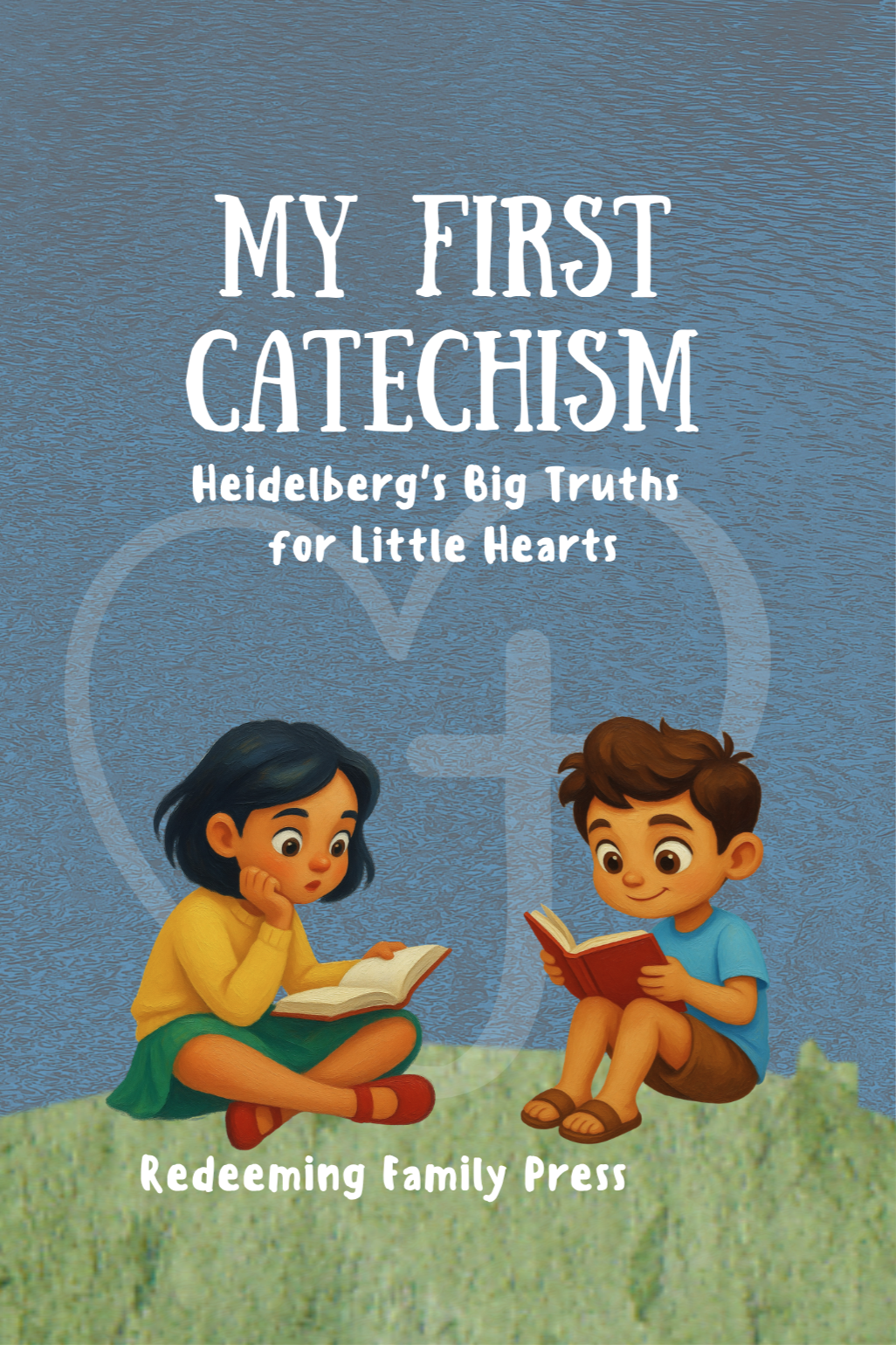
This is a pre-order. Books will be shipped out in October.
A historic and timeless document is now brought to the next generation in this, easy-to-read simplification of the Heidelberg Catechism. This catechism has aided many Christians throughout the centuries. Let it build your child's knowledge of Christ and encourage them in their walk of faith.